Your Attention is Your Currency: How to Spend It on What Matters
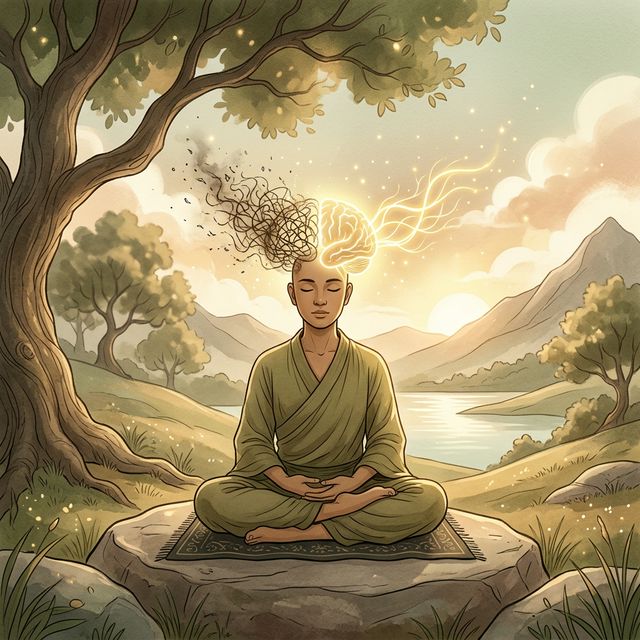
In our modern, hyper-connected world, we are constantly being told that time is our most valuable asset. But there is something even more fundamental than time: Attention. Time is the container, but attention is the currency. Where you spend it determines the quality of your life.
As the saying goes, "Attention is your currency to the world—be wise how you use it." At our core, we believe in giving you the tools to spend that currency on the things that truly matter to you.
But how do we reclaim our attention when our minds are constantly flooded with "mental noise"? The answer lies in a fascinating neurological "see-saw" inside your brain.
The Brain's Internal See-Saw
To find quiet, we have to understand the relationship between two specific networks: the Default Mode Network (DMN) and the Sensory-Somatic Network.
1. The "Narrator" (The DMN)
When your mind is racing—worrying about a meeting, replaying an old argument, or judging yourself—your Default Mode Network is in the driver's seat.
- The Function: It creates the "I" story (e.g., "I hope they like me").
- The Problem: The DMN is "noisy" because it is constantly simulating the past or future to ensure survival. It is rarely in the now.
2. The "Feeler" (The Sensory Cortex)
When you shift your focus to the physical—like the feeling of your breath or the sensation in your right thumb—you activate the Sensory Cortex.
- The Function: It processes raw data: touch, temperature, and position.
- The Magic: The sensory cortex lives strictly in the present. Your thumb cannot feel an "itch from next Tuesday." It can only feel what is happening now.
How the "Quieting" Happens
We don't quiet the mind by "fighting" thoughts; we quiet it through Neural Inhibition. When you focus intensely on sensory input, you are manually directing your brain's "spotlight" (the Thalamus) away from the Narrator and toward the Feeler.
- Starving the Narrator: By processing the intricate sensations of the body, the brain withdraws metabolic energy from the DMN.
- Breaking the Loop: Mental noise requires a loop where a thought triggers a feeling, which triggers another thought. Focusing on raw sensation breaks that circuit. The story simply runs out of fuel.
The Shift: From Story to Presence
By moving from the "Narrator" to the "Feeler," you transition from viewing yourself as a "story" in time to being a "witness" of the present moment.
| Feature | Mental Noise (DMN) | Quiet Awareness (Sensory Cortex) |
|---|---|---|
| Time Orientation | Past / Future | Right Now |
| Brain Activity | Abstract Thought / Judgment | Raw Sensation / Vibration |
| Identity | "I am [Label]" | "I am experiencing [Sensation]" |
| Nervous System | Often High Stress (Sympathetic) | Deep Calm (Parasympathetic) |
Reclaim Your Currency
The most effective way to quiet the mind—whether through Yoga Nidra, mindfulness, or deep focus—is to give the brain something more interesting and immediate to do: feeling the body.
When you stop fighting the noise and start investing your attention in the present sensation, the "narrator" finally falls asleep, and you regain control over your most precious resource.
Ready to experience this?
Try a Kosha session — our guided Yoga Nidra uses this exact mechanism to shift your brain from noise to stillness.
Start a Session